
AI Risk & Governance Strategy
Verified Sources
Deploy AI with speed and defensibility - without turning 'close enough' into your operating standard.
Defensible AI Adoption
AI risk is now business risk - operational, reputational, and increasingly legal. Governance is what keeps AI from scaling into liability. SEIKOURI turns real-world AI failure patterns into strategy, controls, and decision rights that hold up under scrutiny.
What we mean by risk and governance
AI Risk
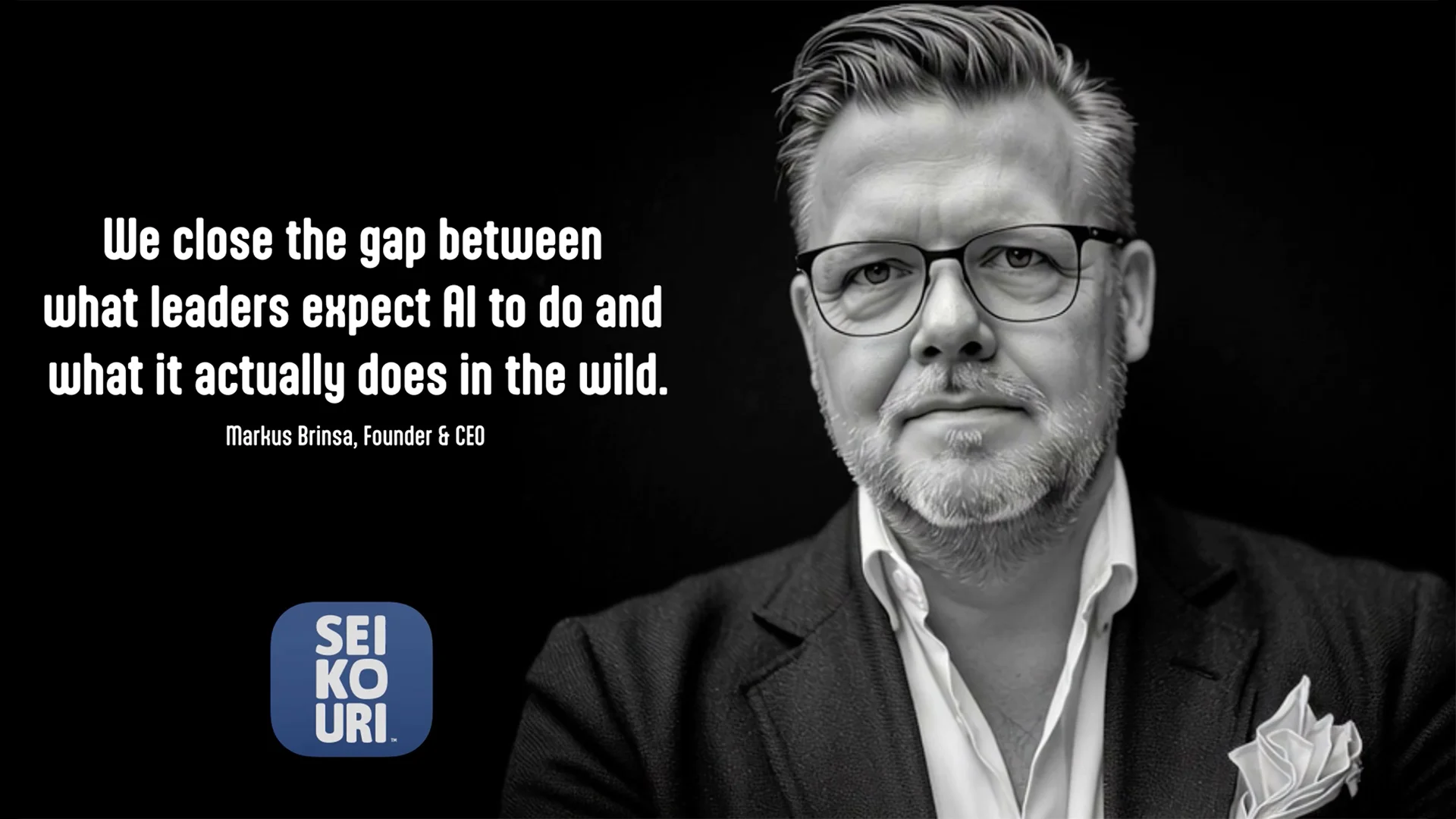
We close the gap between what leaders expect AI to do and what it actually does in the wild.
AI risk isn’t theoretical anymore. It’s operational, reputational, and increasingly legal—and it shows up in the gap between what leaders believe AI will do and what these systems actually do in the wild. SEIKOURI helps investors, founders, and enterprise teams close that gap. We run ongoing AI risk research to map how modern models fail, how those failures propagate through organizations, and which patterns repeat across industries: unreliable outputs that get treated as “close enough,” agents that blur decision boundaries, and security exposures like prompt injection and data leakage that turn ordinary workflows into attack surfaces. We convert that intelligence into strategy: where to deploy AI, where not to, which controls are non-negotiable, how to design escalation paths, what to demand from vendors, and how to communicate capability without creating liability. The outcome is faster adoption with fewer avoidable incidents, fewer downstream surprises, and a posture that holds up under scrutiny.
AI Governance
Governance that executives can defend and teams can actually run.
AI governance is the difference between an AI program that scales and one that quietly becomes uninsurable. It’s not policy theater and it’s not a binder on a shelf—it’s a system of decision rights, operational controls, and accountability that matches the speed of deployment. SEIKOURI designs governance that executives can defend and teams can actually run: what gets approved, what gets logged, what gets tested, what gets escalated, and who owns the call when the model is wrong or the automation crosses a line. We build governance around real deployment conditions—multiple vendors, shifting models, evolving regulations, and employees who will route around friction—so controls are enforceable instead of aspirational. The result is a governance layer that accelerates procurement and enterprise adoption, reduces compliance and litigation exposure, and creates the trust required to move from pilot to platform.
The cost of 'close enough' is rising
AI risk is rising faster than most organizations’ ability to manage it. Models are improving, but the real acceleration is happening in deployment: more tools, more vendors, more integrations, and more autonomy embedded into everyday workflows. That expansion increases surface area and makes small failures travel farther—into customer interactions, internal decisions, security posture, and public perception. At the same time, procurement, regulators, and plaintiffs are getting sharper about accountability. The era of “we’re experimenting” as a blanket excuse is ending. The organizations that win will be the ones that treat risk and governance as operating requirements—because defensible speed is now a competitive advantage.
Risk map
Reliability and decision risk
AI fails most often in the most boring way: it sounds confident while being wrong. The risk isn’t a single hallucination—it’s what happens when teams normalize “close enough” and outputs quietly become decisions, customer communications, policies, or forecasts. Reliability risk compounds when there are no verification expectations, no evaluation gates, and no clear rule for when a human must intervene. If your organization can’t consistently tell the difference between a draft and a decision, AI will eventually decide for you.
Security and data exposure
Most AI security incidents are workflow incidents. Prompt injection turns untrusted input into instructions that bend the system’s behavior, and data exposure happens when sensitive content is pasted, retrieved, or logged in the wrong place—often by well-meaning employees trying to move fast. Risk grows when tools have broad permissions, unclear retention rules, or are connected to large internal repositories without tight access boundaries. In practice, a “helpful” assistant can become a new entry point for leakage, exfiltration, and contractual violations.
Autonomy and control risk
The step from chatbot to agent changes the risk profile: wrong answers become wrong actions. When systems can send messages, update records, trigger workflows, or call APIs, the central question becomes decision rights—what the agent is allowed to do, under what conditions, and who owns the call when it crosses a line. Control risk spikes when autonomy expands faster than oversight, when teams can’t explain who approved what authority, or when there’s no hard kill switch. If accountability is unclear, the automation becomes policy by default.
Legal and compliance risk
AI becomes legal risk when organizations make claims they can’t defend, use AI in regulated decisions without guardrails, or can’t produce documentation showing how systems behaved. Liability concentrates around sensitive domains, customer harm, bias, privacy, and data handling—especially when vendor changes and model updates quietly shift behavior over time. Compliance isn’t just about laws; it’s also procurement standards, audits, and contracts that require traceability. When you can’t explain the “why” behind an output or action, the organization absorbs the exposure.
Reputational and trust risk
Reputation doesn’t collapse because the model made a mistake—it collapses because the organization looks careless, evasive, or unaccountable about mistakes. The fastest trust-killers are confident misinformation, unsafe recommendations, biased outputs, and “the AI did it” excuses when something goes wrong. Once public trust cracks, commercial trust follows: procurement freezes, churn increases, and partnerships slow down. In AI, credibility isn’t branding—it’s operational behavior that customers and stakeholders can see.
How to fix it
Strategy
Fixing AI risk starts with deciding what you will and won’t let AI do. That means choosing use cases based on consequence, not novelty—defining where AI belongs in the business, where it must remain assistive, and where it should not be used at all. A good strategy sets boundaries for automation, clarifies risk tolerance by function, and prevents “pilot gravity,” where experiments quietly expand into production without executive intent. The goal is simple: speed with limits that are explicit, not assumed.
Controls
Controls turn intention into reality. Guardrails, escalation paths, evaluation thresholds, monitoring, logging, and access rules are how you prevent predictable failures and contain blast radius when something slips through. The most effective controls are the ones that match real workflows: they assume people will be busy, vendors will change, and models will drift. If you can’t test it, log it, and escalate it, you can’t govern it—so the system becomes fragile as it scales.
Governance operating model
Governance is where accountability stops being a slogan. It defines decision rights—what gets approved, what gets recorded, what gets tested, what gets escalated, and who owns the call when the model is wrong or the automation crosses a line. Good governance is enforceable and fast: it reduces internal friction by making responsibilities clear, and it accelerates procurement by making oversight visible. If governance lives only in documents and not in operating routines, it will be bypassed.
Preparedness
Preparedness is the key to preventing AI incidents from becoming enterprise crises. You need a clear incident playbook, escalation rules, a kill switch for unsafe automation, and communication standards that reduce panic and improvisation under pressure. Tabletop exercises matter because they expose where accountability breaks in real time—before customers, regulators, or the press do it for you. The goal isn’t to assume failure; it’s to ensure that, when it does, your response is disciplined, credible, and fast.
How we engage
SEIKOURI turns AI risk and governance into an executable operating posture—not a compliance project and not a slide deck. We start with how systems behave in real deployment conditions—vendor churn, model drift, messy workflows, and humans who route around friction—then build decision rights, controls, and rollout standards that hold up under scrutiny. Engagements are designed to create momentum fast, install what’s missing, and keep governance current as your AI stack evolves.
Risk & Governance Snapshot
Who it’s for: Leaders who need clarity before AI scales into policy, investors doing diligence, and teams preparing for a launch or expansion.
What you get: A fast diagnostic of your highest-risk use cases, where risk actually sits in the workflow, and the control gaps blocking defensible scale.
Outcome: A prioritized action plan—what to fix first, what to stop, what standards to adopt, and what “safe to scale” means for your organization.
Guardrails & Governance Sprint
Who it’s for: Organizations moving from pilot to production, launching agents, or deploying AI into customer-facing and high-impact workflows.
What you get: Installed guardrails and an operating model teams can run: decision rights, escalation paths, evaluation gates, logging expectations, vendor requirements, and rollout standards aligned to real deployment conditions.
Outcome: Faster adoption with fewer preventable incidents—governance that accelerates procurement confidence and turns pilots into repeatable programs.
Control Tower Retainer
Who it’s for: Organizations running multiple AI tools, vendors, teams, or regions where governance must stay current as systems evolve.
What you get: Ongoing oversight and risk intelligence: deployment reviews, model/vendor change impact assessments, incident preparedness drills, and executive-ready reporting that keeps accountability clear.
Outcome: Continuous defensibility—your AI program stays resilient through drift, churn, and change without slipping into ad-hoc decisions or governance theater.
Built from real failure patterns
SEIKOURI’s AI risk and governance work is grounded in continuous research and direct exposure to how AI behaves in production—not how it looks in demos. We track emerging failure modes across tools, industries, and deployment models, then translate those patterns into operator-grade strategy: decision rights that reduce ambiguity, controls that hold under pressure, and governance that survives vendor churn and model drift. Our cross-border footprint adds a practical advantage: we design for real procurement environments, real regulatory trajectories, and real reputational risk across markets. The result is not a compliance layer—it’s a defensible operating posture that allows clients to scale AI with confidence. A public-facing slice of this work shows up in Chatbots Behaving Badly—used to educate, stress-test assumptions, and keep the conversation honest.
Next step
If you are deploying AI into real workflows, the fastest path to defensible speed is to start with a clear risk map, a governance posture your teams can run, and standards that scale. Start with a Risk & Governance Snapshot.
Let's get in touch. DM or email me. ceo@seikouri.com